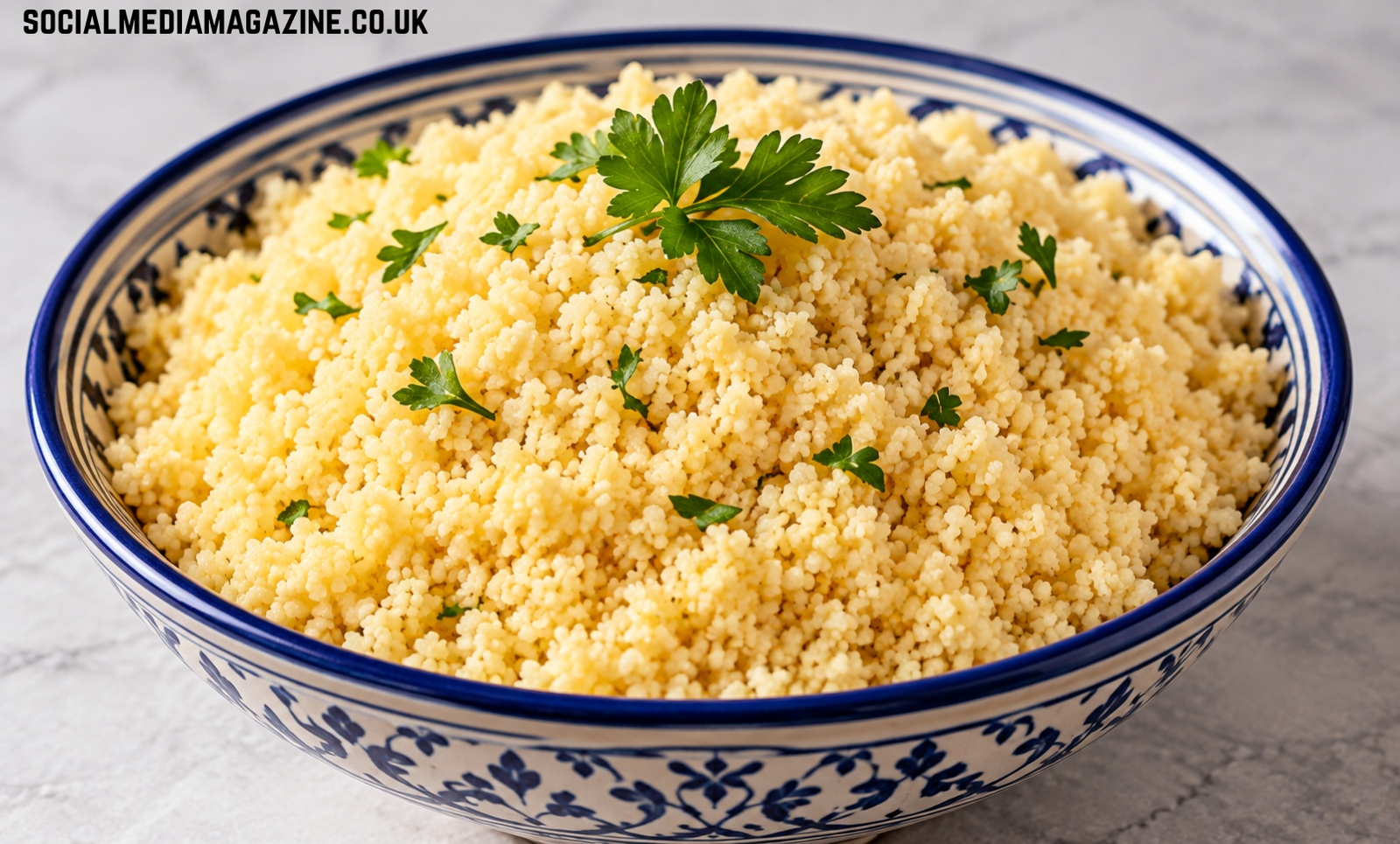
Kouskousi is a traditional grain-based food closely associated with North African cooking. Commonly recognized as couscous, it consists of small granules generally made from durum wheat semolina. Once prepared, these granules become tender and separate easily, making them suitable for meals containing vegetables, meat, legumes, or sauces. Its relatively neutral taste allows it to accompany many different ingredients without overpowering their flavors.
The food has a long history connected with family cooking, agriculture, and regional traditions. In several North African communities, preparing couscous has historically involved more than making an ordinary meal. It can be part of family gatherings, religious occasions, and shared celebrations. Ready-made couscous has simplified home cooking, but older preparation techniques still reveal much about its culinary heritage.
What Is Kouskousi?
Kouskousi refers to a food prepared from small particles of wheat semolina that are moistened, shaped into granules, and traditionally cooked with steam. Unlike naturally occurring grains such as rice, couscous is a processed wheat product. Its appearance resembles a small grain, but its production involves techniques more closely related to making pasta.
The finished food is usually served as a base for other ingredients. It can absorb broth, vegetable juices, and seasonings while retaining a relatively light texture when properly prepared. In traditional North African meals, couscous is often accompanied by a vegetable stew or a combination of meat and chickpeas. Other preparations use milk, dried fruit, or sweet ingredients.
Where Does Kouskousi Come From?
The strongest historical and cultural associations of couscous are with the Maghreb, the northwestern region of Africa that includes Morocco, Algeria, Tunisia, and neighboring countries. Its development is commonly linked to the Amazigh, also known as Berber, populations who have lived across North Africa for centuries. Wheat cultivation and traditional grain-processing techniques helped establish couscous as an important part of regional food practices.
Identifying one country as its exclusive birthplace is difficult because the dish developed before modern national borders existed. Different communities have preserved their own methods, ingredients, and serving customs. Morocco, Algeria, Tunisia, and Mauritania share a recognized couscous heritage, although their regional dishes are not identical. Its historical importance is better understood as part of a wider North African culinary tradition rather than the invention of one modern country.
Which Language Does the Word Kouskousi Come From?
The familiar English word couscous entered European languages through North African linguistic traditions. It is generally traced to Amazigh terminology, although the precise linguistic development and original meaning are debated. Arabic also uses related forms, including kuskus, reflecting the long interaction between Amazigh-speaking and Arabic-speaking communities.
Kouskousi is a less familiar spelling that may appear in discussions of couscous and related regional foods. However, it should not automatically be treated as the standard spelling in every North African language. Names and pronunciations vary across communities. The similarities between these terms reflect the movement of food traditions through languages, trade, migration, and cultural contact.
The Historical Development of Kouskousi
Couscous has been prepared in North Africa for many centuries, although its exact beginning remains uncertain. Medieval culinary writings mention couscous, while archaeological discoveries offer additional evidence through utensils associated with early steaming practices. Food historians generally recognize its deep North African roots, but claims that it originated in one precise ancient year are difficult to establish.
The movement of merchants and communities across the Mediterranean helped introduce couscous to regions beyond its North African roots. It appeared in different forms in parts of southern Europe and the Middle East. Over time, households adapted recipes according to locally available grains, vegetables, spices, and cooking preferences. Despite these changes, the basic practice of preparing small granules and serving them with complementary foods remained recognizable.
How Is Kouskousi Traditionally Made?
Traditional couscous production begins with semolina obtained from durum wheat. A small quantity of water is added to the semolina, and the mixture is worked by hand to form tiny particles. Additional dry semolina may be used to prevent excessive sticking. The granules are then separated by size, often using a sieve, so that they cook more evenly.
The prepared granules are placed in the upper section of a steaming vessel while a stew or boiling liquid cooks underneath. Steam passes through the couscous, gradually softening it. During preparation, the granules may be removed, loosened by hand or with utensils, lightly moistened, and steamed again. Repeating this process helps produce a tender texture without allowing the particles to form large clumps.
How Does the Cooking Process Work?
The cooking method depends on whether the product is traditional uncooked couscous or a commercially precooked variety. Traditional couscous generally requires steaming because its granules need sufficient moisture and heat to become fully tender. The repeated steaming process also allows the cook to control texture and prevent uneven cooking.
Most instant couscous sold in supermarkets has already been steamed and dried during manufacturing. At home, it can usually be prepared by adding a measured amount of hot water or broth, covering the container, and allowing the granules to absorb moisture. After several minutes, the couscous is loosened with a fork. The correct liquid quantity and resting time depend on the manufacturer’s instructions.
Different Types of Kouskousi
Couscous varies in size, ingredients, and regional preparation. Some varieties consist of extremely small granules, while others have a noticeably larger shape. The differences influence cooking time, mouthfeel, and suitability for particular recipes.
1. Traditional Fine Couscous
Fine couscous is widely associated with North African cooking. Its small particles cook relatively quickly and produce a delicate texture. It is commonly served with vegetable stews, chickpeas, lamb, chicken, or seasoned broth.
Because the granules are small, careful moisture control is important. Excessive liquid or unnecessary stirring can make the finished dish heavy and sticky. Traditional steaming techniques are particularly useful for maintaining separation between the particles.
2. Medium and Coarse Couscous
Medium and coarse couscous contain larger granules that create a more noticeable texture. Depending on the product, they may require additional liquid or longer preparation than fine couscous. These varieties are useful when a dish needs a firmer base.
They can accompany stews containing larger vegetables or meat pieces. However, package labels should be checked because manufacturers do not always use identical size classifications.
3. Whole-Wheat Couscous
Whole-wheat couscous is produced using whole-grain wheat material rather than relying only on refined semolina. It generally contains more dietary fiber than conventional refined couscous, although the exact amount depends on the product.
Its flavor may be slightly more pronounced, and its texture can feel firmer. People looking to increase their whole-grain intake may prefer this version, especially when combining it with vegetables, beans, and other fiber-rich ingredients.
4. Pearl Couscous
Pearl couscous, often called Israeli couscous or ptitim, consists of larger, rounded pieces of wheat-based pasta. Unlike traditional North African couscous, it is generally manufactured through a pasta-forming and toasting process.
It has a chewier texture and is frequently cooked by boiling or simmering. Pearl couscous works well in salads, soups, and warm dishes. Although the name suggests a close relationship, its production and culinary history differ from those of traditional couscous.
Regional Differences in Kouskousi Recipes
In Morocco, couscous is frequently prepared with a mixture of vegetables and meat, with certain family meals featuring several different vegetables. Some Moroccan preparations combine couscous with caramelized onions, raisins, and warm spices. The exact ingredients depend on household traditions and regional preferences.
Algerian recipes vary considerably between communities, with different sauces, vegetables, and proteins. Tunisian couscous is often associated with tomato-based sauces and stronger seasoning, although not every Tunisian version is spicy. In Mauritania and other areas, local grains and culinary practices influence preparation. These differences demonstrate how one basic food can support several distinct cooking traditions.
Nutritional Value of Kouskousi
Couscous primarily supplies carbohydrates, which the body uses as an energy source. It also provides modest amounts of protein and small quantities of minerals. Its nutritional profile depends on the wheat used, whether the product is enriched, and the ingredients added during cooking.
The following figures represent approximate values for 100 grams of plain, cooked, conventional couscous prepared with water.
| Nutrient | Approximate amount |
|---|---|
| Calories | 112 kcal |
| Carbohydrates | 23.2 g |
| Protein | 3.8 g |
| Fat | 0.2 g |
| Dietary fiber | 1.4 g |
| Selenium | 27.5 µg |
| Water | 72.6 g |
These values describe cooked couscous, not the dry product. Dry couscous contains substantially more calories per 100 grams because it has not absorbed cooking water. Adding butter, oil, meat, or sauces also changes the nutritional content of the complete meal.
Potential Health Benefits of Kouskousi
Provides Energy for Daily Activities
The main nutritional contribution of couscous comes from its carbohydrate content. The digestive system converts carbohydrates into simple sugars, providing the body’s cells with energy for their normal functions. This makes couscous a practical component of meals intended to provide energy for ordinary physical and mental activities.
The nutritional contribution of couscous also depends on the ingredients served alongside it. A meal containing couscous, vegetables, beans, and a source of protein offers a broader nutritional range than a serving of plain couscous alone. Portion size also matters because eating large amounts increases the total carbohydrate and calorie intake.
Supplies Selenium
Conventional wheat couscous can provide selenium, an essential trace mineral involved in antioxidant defense and normal thyroid function. The amount present in the finished product depends on the wheat and its growing conditions.
Selenium contributes to several normal biological processes, but consuming more than the body needs does not automatically improve health. Couscous should be considered one possible dietary source rather than a treatment for thyroid disorders or other medical conditions.
Can Support a Balanced Diet
Couscous can be combined with foods that provide nutrients it contains in smaller amounts. Chickpeas and lentils add plant protein and fiber, while vegetables contribute vitamins, minerals, and different plant compounds. Olive oil, nuts, or seeds may supply unsaturated fats.
This flexibility makes couscous useful in both meat-based and vegetarian meals. Its health value comes largely from the overall composition of the dish rather than any special property of couscous itself.
Is Kouskousi Good for Digestion?
Couscous is generally easy to prepare and has a soft texture after cooking. However, its effect on digestion varies between individuals. Because much of its natural fiber is removed during processing, refined couscous provides only a modest amount of dietary fiber.
Whole-wheat couscous may provide more fiber, which contributes to normal bowel function. Combining either variety with vegetables and legumes can also increase the fiber content of a meal. Individuals with digestive sensitivities should pay attention to the type of wheat product, serving size, and other ingredients.
Can People With Diabetes Eat Kouskousi?
People with diabetes may include couscous in their diets, but carbohydrate quantity requires attention. Because couscous contains starch, eating it can increase blood glucose levels. The response depends on portion size, the type of couscous, preparation, and the other foods consumed alongside it.
Whole-wheat versions may offer more fiber, but they still contain carbohydrates. Pairing couscous with non-starchy vegetables, protein, and healthy fats can help create a more balanced meal. Individual carbohydrate targets should follow medical or dietetic advice rather than assuming that one grain is suitable for everyone in unlimited amounts.
Does Kouskousi Contain Gluten?
Since traditional couscous uses wheat as its primary ingredient, gluten is naturally present in the finished product. It is unsuitable for people with celiac disease and for individuals who must strictly avoid wheat gluten. The small size of the granules does not change this fact.
Some products marketed as gluten-free couscous use alternative ingredients such as corn, rice, or other grains. These are substitutes rather than conventional wheat couscous. People with celiac disease should check the ingredients and gluten-free certification carefully because cross-contact during manufacturing may be a concern.
What Is the Difference Between Kouskousi, Rice, and Quinoa?
Couscous, rice, and quinoa can serve similar purposes in a meal, but they are not the same type of food. Couscous is generally manufactured from wheat semolina, rice is a cereal grain, and quinoa is a seed commonly used like a grain.
| Feature | Couscous | Rice | Quinoa |
|---|---|---|---|
| Main source | Durum wheat | Rice plant | Quinoa plant |
| Naturally gluten-free | No | Yes | Yes |
| Typical texture | Small, soft granules | Separate grains, varying by type | Small seeds with a slight bite |
| Protein | Moderate amount | Generally lower, depending on type | Generally higher per cooked serving |
| Cooking method | Hydration or steaming | Boiling, steaming, or absorption | Simmering in liquid |
Each food can fit into a balanced diet. Compared with refined couscous, quinoa usually contains higher amounts of protein and fiber, whereas rice is naturally free from gluten. Couscous is particularly convenient when a quick-cooking base is needed.
Why Do People Use Kouskousi in Everyday Cooking?
One reason couscous remains popular is its ability to work with many ingredients. It can be served hot with stew, cooled for salads, or combined with herbs and roasted vegetables. Its relatively mild taste allows cooks to adjust seasonings according to personal preferences.
Commercial instant couscous also requires little preparation time. This makes it convenient for households that need a quick side dish. Traditional versions take longer but allow greater control over texture and preserve cooking techniques associated with North African food culture.
Factors That Affect the Quality of Kouskousi
Several factors determine whether cooked couscous becomes light and separate or wet and clumped. Granule size is important because smaller particles generally hydrate more quickly. The quantity of water also influences texture. Too little moisture can leave the center firm, while excessive liquid may make the granules sticky.
Storage conditions matter as well. Dry couscous should be kept in a sealed container away from moisture, heat, and insects. Whole-wheat products may have a shorter storage life because of their natural oil content. Checking the package date, examining the product for unusual odors, and following storage instructions help maintain quality.
Common Mistakes When Preparing Kouskousi
A frequent mistake is treating every couscous product as though it requires the same cooking method. Instant couscous, traditional uncooked couscous, and pearl couscous have different preparation requirements. Using instructions intended for another variety can produce an unsatisfactory result.
Using excessive water or constantly mixing the grains during moisture absorption can also affect their final texture. For many instant varieties, covering the container and allowing the liquid to absorb before gently fluffing produces better results. When preparing traditional steamed couscous, separating the particles between steaming stages helps maintain an even texture.
Practical Ways to Make Kouskousi Part of a Nutritious Diet
A practical way to serve couscous is to use it as the carbohydrate portion of a meal rather than the only substantial ingredient. Roasted vegetables, lentils, chickpeas, fish, chicken, or tofu can be added depending on dietary preferences. Herbs, lemon juice, and modest amounts of olive oil can provide flavor without relying entirely on salt-heavy sauces.
For a simple vegetable dish, cooked couscous can be combined with carrots, zucchini, chickpeas, parsley, and a light dressing. A more traditional approach involves serving it beneath a slow-cooked vegetable and meat stew. Both methods illustrate how couscous can be adapted without changing its basic role in the meal.
Cultural Importance of Kouskousi
Couscous has a social meaning that extends beyond nutrition. In many North African households, it is connected with hospitality and the practice of sharing food. Large serving dishes allow several people to eat together, and preparation techniques have traditionally been passed from older family members to younger generations.
In 2020, UNESCO inscribed the knowledge, practices, and traditions associated with the production and consumption of couscous on its Representative List of the Intangible Cultural Heritage of Humanity. The multinational nomination involved Algeria, Mauritania, Morocco, and Tunisia. This recognition emphasizes the cultural practices surrounding couscous rather than identifying a single country as its exclusive origin.
Things to Consider Before Eating Kouskousi Regularly
Couscous can be part of an ordinary diet, but several considerations are worth remembering. People with wheat allergies or celiac disease must avoid conventional wheat couscous. Those monitoring blood glucose may need to adjust their portions, while people seeking higher fiber intake may benefit from choosing whole-wheat versions.
The nutritional value of a finished dish also depends heavily on preparation. Large quantities of butter, salt, fatty meat, or rich sauces can significantly change its nutritional profile. Choosing varied ingredients and reasonable serving sizes is more useful than judging couscous as automatically healthy or unhealthy.
Conclusion
Kouskousi, commonly associated with couscous, represents a long-established North African food tradition built around the preparation of small wheat-based granules. Its history reflects agricultural practices, regional cooking methods, and the exchange of food customs across communities. Although the exact point of origin remains uncertain, its connection with Amazigh heritage and the wider Maghreb is well established.
From traditional steamed preparations to convenient packaged products, couscous continues to serve as a flexible base for different meals. Understanding its ingredients, nutritional properties, varieties, and preparation methods helps people choose the form that suits their needs. Its lasting importance comes from both its practical role as food and the cultural traditions maintained through generations.