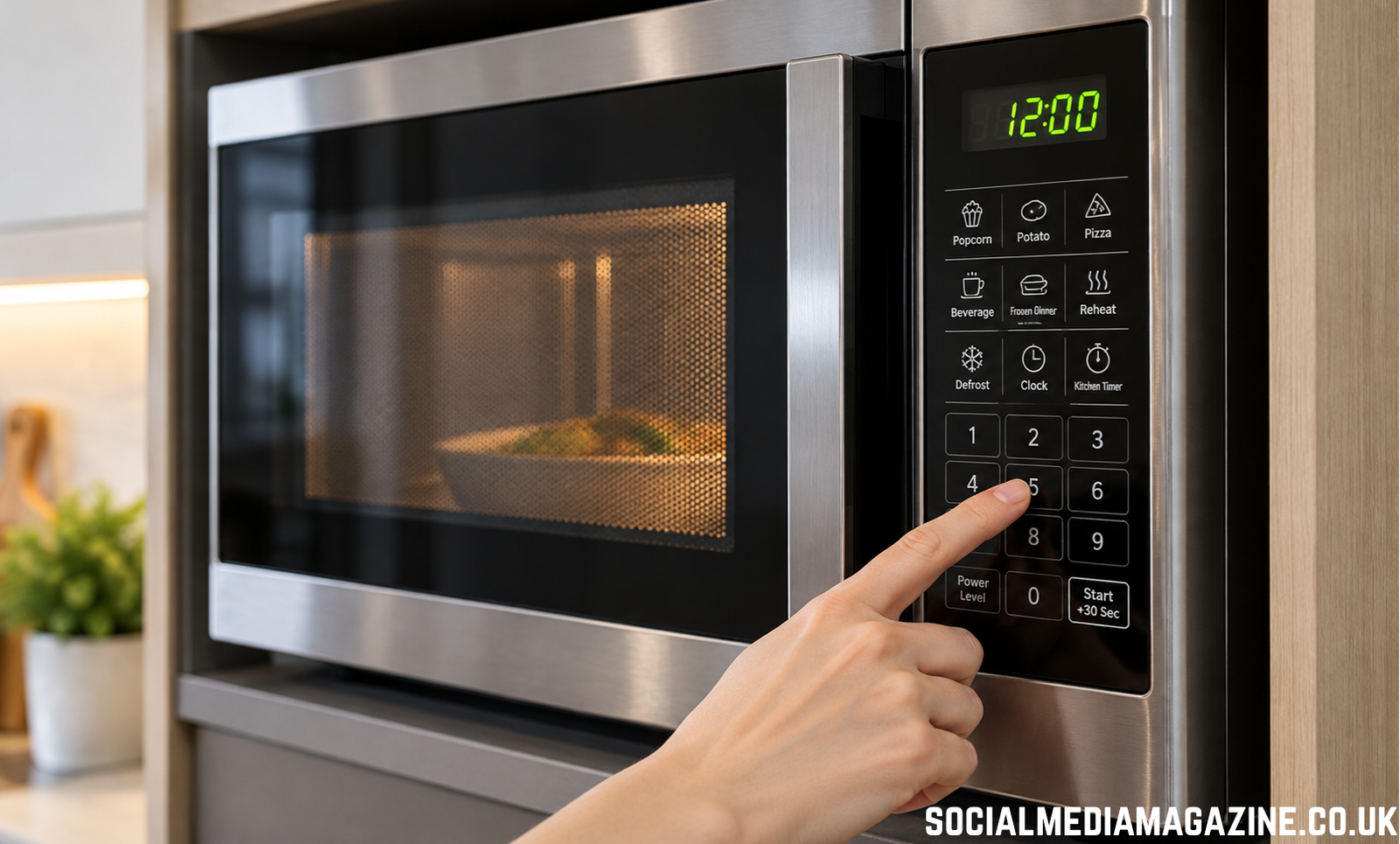
Designed for household food preparation, a microwave oven converts electrical power into electromagnetic energy that raises the temperature of food placed inside its cooking chamber. Some people casually refer to this appliance as a microwey, although microwave is its correct and widely accepted name. It is commonly used for warming refrigerated meals, preparing simple dishes, defrosting frozen ingredients, and heating beverages. Its ability to complete many everyday kitchen tasks within a short period has made it a familiar appliance in homes, offices, and commercial food establishments.
Rather than relying solely on a burner, heated cookware, or surrounding hot air, microwave cooking generates warmth through the absorption of electromagnetic energy within the food itself. This difference allows certain foods to heat relatively quickly. However, the appliance also has limitations, particularly when preparing dishes that require browning or a crisp exterior. Learning about its invention, construction, features, and safe operation provides a clearer understanding of how it became an important part of kitchen equipment.
What Is Microwey?
The term microwey is an informal variation of microwave, generally referring to the same kitchen appliance rather than a separate product or technology. A microwave oven is designed to warm food by directing electromagnetic energy into a specially constructed cooking compartment. Its main purpose is to make food preparation more convenient, particularly when cooking or reheating smaller portions.
Most microwave ovens contain a cooking chamber, control panel, door, heating system, and rotating plate. Users place food inside a suitable container, select the required power and time, and allow the machine to complete the heating cycle. Different models offer additional functions, including automatic cooking programs, grilling, defrosting, and convection heating. These options determine whether the appliance is suitable mainly for reheating or can perform a wider range of cooking tasks.
Who Invented the Microwave Oven?
The invention of the microwave oven is associated with Percy Spencer, an American engineer who worked for Raytheon. Spencer was involved in developing radar equipment during the 1940s, when electronic technology was undergoing considerable development because of military research. His work included equipment containing magnetrons, electronic devices capable of producing microwave energy.
In 1945, Spencer noticed that a chocolate bar in his pocket had melted while he was working near operating radar equipment. This observation encouraged him to investigate whether electromagnetic waves could deliberately heat food. He subsequently conducted experiments involving different food items, helping demonstrate that microwave energy could be used for cooking. His work became the foundation for a new category of electrical kitchen appliances.
When and Where Did Microwey First Appear?
The earliest development of microwave cooking took place in the United States during the mid-1940s. Raytheon filed a patent application relating to microwave cooking in 1945, following Spencer’s experiments. The company introduced its first commercial microwave oven, known as the Radarange, in 1947.
These early machines were very different from household microwave ovens. They were large, expensive, and required installation arrangements unsuitable for most domestic kitchens. Their size and operating requirements meant they were mainly intended for commercial environments. The technology became more practical for ordinary consumers only after manufacturers developed smaller equipment and improved its operating systems.
How Microwave Ovens Became Common in Homes
During the 1950s, manufacturers began exploring ways to adapt microwave cooking for residential use. Tappan introduced an early household microwave model in 1955, although its price and installation requirements limited widespread adoption. A more significant development occurred in 1967 when Amana introduced a countertop Radarange that could fit into a domestic kitchen more easily.
The 1970s and 1980s brought further improvements in appliance size, production methods, and affordability. Microwave ovens gradually became more accessible to households, particularly as manufacturers introduced simpler controls and additional cooking settings. Their increasing popularity was also supported by the availability of frozen meals and packaged foods intended for microwave preparation.
How Does a Microwey Work?
A microwave oven uses an electronic component called a magnetron to generate electromagnetic waves. These waves enter the cooking chamber and interact with substances inside food, particularly water and other electrically responsive molecules. As energy is absorbed, heat is produced, raising the food’s temperature.
Microwave energy does not necessarily heat every part of a dish at the same rate. Its penetration depends on the food’s composition, thickness, and arrangement. Heat also moves from warmer areas toward cooler sections through conduction. This explains why food may require stirring, turning, or standing time after heating. Many appliances include rotating plates to improve the distribution of microwave energy and reduce uneven cooking.
Main Parts of a Microwave Oven
Several components work together to operate a microwave oven. The magnetron generates the microwave energy, while the waveguide directs that energy into the cooking compartment. The metal cooking chamber helps contain the electromagnetic waves, and the door incorporates protective screening and safety mechanisms.
The control panel allows users to choose heating times, power levels, and cooking programs. A turntable motor rotates the glass plate in many models, helping expose different parts of the food to the microwave field. Cooling fans and electronic circuits support operation and help manage heat generated by the equipment. Although these parts are usually hidden behind the appliance’s outer casing, each performs an important function.
Important Features of Microwey
Microwave ovens contain several features intended to improve convenience and cooking control. Adjustable power settings are among the most useful because different foods require different heating conditions. High power may be suitable for reheating certain meals, while reduced power can help soften butter or thaw frozen ingredients more gradually.
Many models also include automatic cooking programs, digital timers, child-lock controls, and defrost settings. More advanced appliances may use sensors to estimate cooking progress based on steam or humidity. Some include inverter technology that allows more consistent power delivery at lower settings. The availability of these features depends on the model, manufacturer, and intended price range.
Different Types of Microwave Ovens
Microwave ovens are manufactured in several forms, each intended for particular cooking requirements. The three commonly discussed cooking categories are solo, grill, and convection microwave ovens. They differ mainly in the heating methods they provide.
1. Solo Microwave Oven
A solo microwave is designed primarily for ordinary microwave heating. It can reheat cooked food, warm drinks, defrost ingredients, and prepare dishes suitable for microwave cooking. This type is generally appropriate for users who do not require baking or dedicated grilling functions.
Basic solo microwaves usually feature simple operating settings and a less complicated internal design compared with models offering multiple cooking functions. Their limitations become noticeable when preparing foods that require a browned or crisp surface, since ordinary microwave heating is not designed to reproduce the results of traditional grilling or roasting.
2. Grill Microwave Oven
A grill microwave combines electromagnetic heating with an additional heating element. This element allows the appliance to brown the surface of certain foods, making it useful for tasks that ordinary microwave heating cannot perform as effectively.
Depending on the appliance, users may be able to operate the microwave and grill separately or combine both functions. This makes grill models suitable for selected sandwiches, vegetables, and other dishes that benefit from surface browning.
3. Convection Microwave Oven
A convection microwave includes a heating system that circulates hot air around the cooking compartment. This allows it to perform certain functions associated with conventional ovens, including baking and roasting.
Some convection models also combine microwave heating with circulating hot air to reduce cooking time for suitable recipes. However, cooking performance varies between appliances, and users should follow the manufacturer’s instructions when selecting cookware, racks, and operating modes.
4. Built-In and Countertop Microwave Ovens
Microwave ovens can also be classified according to their installation. Countertop models are freestanding appliances placed on suitable kitchen surfaces. They are commonly chosen because they can be installed without major changes to kitchen cabinetry, provided ventilation and electrical requirements are met.
Built-in microwaves are designed for installation within approved kitchen cabinets or dedicated appliance spaces. They can help organize the kitchen layout, but they require suitable dimensions, ventilation, and installation arrangements. Over-the-range models form another category and are usually installed above a cooking range.
Everyday Uses of Microwey
The most common use of a microwave oven is reheating food that has already been cooked. Rice, pasta, soup, vegetables, and prepared meals can often be warmed without using a stove. This is particularly convenient when someone needs to prepare an individual serving rather than cook an entire meal again.
Microwave ovens can also cook vegetables, prepare oatmeal, melt chocolate, soften certain ingredients, and heat microwave-compatible packaged foods. Defrosting is another practical application, especially when frozen ingredients need to be prepared for immediate cooking. However, the appliance should be used according to food safety guidance, since incomplete or uneven heating can leave some portions at unsafe temperatures.
How to Use a Microwave Oven Properly
Using a microwave begins with selecting a container designed for microwave heating. Suitable glass, ceramic, and clearly labeled microwave-safe containers are generally appropriate. The food should be arranged so that it can heat as evenly as possible, and a suitable cover may be used to retain moisture and reduce splashing.
After placing the dish inside, the user selects the required cooking time and power level. Food may need to be stirred or rearranged during heating, particularly when preparing larger portions. After the microwave stops, leaving the dish untouched for a short time allows the heat to spread more evenly throughout the food. Before eating, users should check that the food has heated thoroughly, especially when reheating meat, poultry, or leftovers.
Everyday Dishes You Can Make Using a Microwave
Microwave ovens are suitable for a variety of simple food preparations. Potatoes, vegetables, oatmeal, and certain egg dishes can be cooked using appropriate methods. Prepared soups, sauces, and beverages can also be heated, while microwave-specific recipes provide options for small cakes and other quick dishes.
Cooking results depend on the ingredients, quantity, container, and appliance power. For example, vegetables containing moisture may cook relatively quickly, while thicker pieces of meat require greater attention to internal temperature. Foods that depend on a dry, crisp exterior often produce better results when finished in an oven, grill, or frying pan.
Materials That Should Not Be Placed in a Microwey
Not every kitchen container is suitable for microwave use. Ordinary metal utensils, containers with metallic decoration, and aluminum foil can create problems unless their use is specifically permitted by the appliance manufacturer. Placing unsuitable metallic items inside a microwave can trigger electrical sparks that may harm its internal surfaces and components.
Containers that are not heat-resistant may melt or become damaged during heating. Tightly sealed jars and other closed containers can also be dangerous because steam pressure may build inside them. Whole eggs in their shells should not be heated in a microwave, as internal pressure can cause them to burst. Users should always check container labels and appliance instructions before heating unfamiliar materials.
Is Microwave Cooking Safe?
Microwave ovens are generally safe when they are properly manufactured, maintained, and operated according to instructions. The electromagnetic energy they use is non-ionizing radiation, meaning it does not have the same properties as ionizing radiation used in certain medical imaging technologies.
Microwave heating does not make food radioactive. The appliance’s metal enclosure and door-screening system are designed to contain microwave energy during operation. Nevertheless, a microwave with a damaged door, faulty latch, or compromised sealing surface should not be used until it has been professionally assessed. Food safety also depends on adequate heating, since microwave ovens can leave cooler areas inside a dish.
Benefits of Using a Microwave Oven
One major advantage of microwave cooking is the reduced time required for many routine kitchen tasks. Reheating a small serving usually takes less preparation than operating a conventional oven. The appliance can also reduce the need for additional cooking equipment when preparing simple meals.
Microwave ovens may consume less energy than larger conventional ovens for certain small portions because they do not require an entire oven cavity to be heated to a high temperature. Their compact design and convenient controls also make them useful in shared accommodation, offices, and kitchens with limited space. However, actual energy savings depend on the appliance and the food being prepared.
Limitations of Microwey
Although microwave ovens are convenient, they cannot reproduce every result achieved through conventional cooking. Ordinary microwave heating does not generally create the browned surfaces associated with frying, grilling, or roasting. Some foods may also lose their preferred texture when reheated.
Uneven heating is another limitation. A meal can contain hot and cold areas even when its surface appears fully warmed. Users therefore need to pay attention to cooking time, stirring, standing periods, and internal temperature. Microwave ovens are best treated as complementary kitchen appliances rather than complete replacements for all other cooking methods.
Practical Ways to Keep Your Microwave Clean and Working Properly
Regular cleaning helps maintain the appliance and prevents food residue from collecting inside the cooking chamber. After the oven has cooled, users can wipe its interior with a soft cloth and a suitable mild cleaning solution. Removable turntables can generally be washed separately, according to the manufacturer’s guidance.
Ventilation openings should remain clear, and the door should close properly without obstruction. Harsh cleaning tools that damage interior surfaces or door seals should be avoided. Strange sounds, visible sparking, smoke, or signs of an electrical fault are reasons to stop using the microwave immediately and arrange a professional safety inspection. Users should not attempt to repair internal electrical components themselves.
How Long Does a Microwave Oven Last?
A household microwave oven may remain usable for approximately seven to ten years, although its actual lifespan can be shorter or longer. The quality of the appliance, frequency of operation, maintenance, and availability of replacement parts all influence how long it continues functioning.
Problems such as inconsistent heating, a malfunctioning control panel, or a damaged door may indicate that repair or replacement is necessary. Some faults can be repaired economically, while others may make replacement more practical. The decision should take into account the appliance’s age, repair cost, and safety condition rather than relying on years of use alone.
How to Choose the Right Microwey
Choosing a microwave oven depends largely on how it will be used. Someone who mainly reheats meals may find a basic solo model sufficient. A household interested in baking or grilling may benefit from a convection or combination appliance with additional heating functions.
Capacity, wattage, available counter space, control design, and cleaning requirements are also important. Buyers should check the appliance’s external dimensions and internal cooking space, since a large exterior does not always guarantee that particular dishes will fit. Warranty coverage, service availability, and energy consumption can further influence the purchasing decision.
The Development of Modern Microwave Technology
Microwave technology has continued to change since the first commercial ovens appeared. Manufacturers have introduced digital controls, improved heating distribution, automatic programs, and power-management systems intended to make cooking more consistent.
Some newer models combine microwave energy with convection heating, grilling, and sensor-based cooking. Others offer connected controls or automated settings for selected foods. These developments expand the ways microwave ovens can be used, although their fundamental purpose remains the same: transferring energy to food for heating and cooking.
Conclusion
The name microwey is sometimes used casually for a microwave oven, whose invention can be traced to American research into electromagnetic heating in the mid-twentieth century. Percy Spencer’s work helped establish microwave cooking, and subsequent improvements transformed early commercial equipment into practical household appliances.
From warming yesterday’s dinner to thawing frozen ingredients and cooking simple recipes, a microwave handles several routine kitchen tasks without requiring extensive preparation. Understanding its different types, operating principles, safety requirements, and maintenance needs allows users to make informed decisions about everyday cooking. While it has limitations, particularly with browning and uneven heating, it continues to serve a practical role in kitchens where convenience and efficient food preparation are important.